A Click Instead of a Queue: The Quiet Digital Revolution in Serbia
On a busy workday in Belgrade, Nenad is at the office, fully occupied with meetings and deadlines. In the middle of it all, he realizes that he needs to change his driving licence due to a recent change of residence.
Until recently, this would have meant taking a full day off work, going to the police administration office, waiting in line, and dealing with paperwork for what is, in essence, a small administrative task.
This time, however, he does not leave his desk.
Through Serbia’s eGovernment portal, Nenad initiates the service online. He logs in using a high level of electronic identification via his mobile phone, activated earlier at a nearby post office close to his workplace.
In just a few minutes, the request is submitted.
No waiting in lines. No unnecessary travel. No lost working day.
The new driving licence will be delivered directly to his home address.
What used to require time, physical presence, and effort is now handled digitally, efficiently, and almost invisibly within the workday.
For Nenad, this is simply normal life. But moments like this quietly tell a much bigger story about how Serbia has been moving closer to the European Union living standards linked to digitalization over the past fifteen years.
Digitalisation: the strongest bridge to the EU
When converge2eu analysts look at how Western Balkan economies are converging with EU living standards, one area clearly stands out in Serbia: digitalisation.
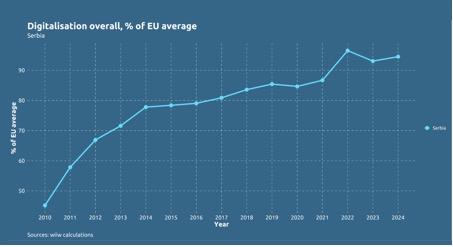
According to recent convergence data, Serbia has reached 94.5% of the EU average in digitalisation. In other words, the country is already operating very close to the level of EU member states in this area. In some parts of the digital economy, Serbia even performs better than the EU average.
Source: www.converge2.eu
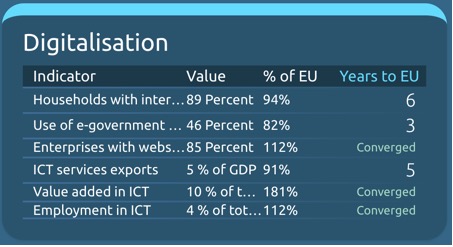
Several indicators highlight just how strong the sector has become:
- ICT value added in the economy reaches over 180% of the EU average, reflecting the strong contribution of digital industries to economic growth.
- Employment in the ICT sector is also higher than the EU average, indicating strong demand for skilled digital professionals.
- ICT exports have grown rapidly and are already around 91% of the EU average, supported by Serbia’s growing role in global digital services.
Because of these results, experts often describe the ICT sector as the “rockstar” of Serbia’s convergence with the EU.
It has been one of the most dynamic and successful areas of economic development in the country.
Progress that citizens can feel
The digital transformation is not only visible in statistics. It is also present in everyday life.
Today, around 2.5 million people in Serbia use the national e-government platform.
See content credentials

For citizens, this means many administrative procedures can now be completed online: applying for documents, submitting forms, accessing public services, or communicating with government institutions.
For businesses, it reduces bureaucracy and saves time.
Instead of spending hours navigating administrative processes, entrepreneurs like Nenad can complete many tasks from their phone or laptop.
The expansion of digital public services has therefore made interactions between citizens, businesses, and the state simpler, faster, and more transparent.
This is one of the most visible ways in which digitalisation contributes to broader economic and social development.
Strategic decisions behind the progress
This digital progress did not happen by chance.
Over the past decade and a half, Serbia has made digital transformation a strategic national priority.
Since 2014 in particular, successive governments have invested heavily in digital infrastructure, modernising public administration, and expanding e-government services.
Source: www.converge2.eu
A key institutional driver of this process has been the Office for IT and eGovernment, which coordinates digital reforms across government institutions. And the trend it is set to continue as digitalization and digital economy have been put in the centre of Serbia’s 2035 Strategy.
These efforts have been supported by a growing private sector in the digital economy, which has expanded Serbia’s capacity in software development, IT services, and digital innovation.
The result is a sector that has become a major engine of economic growth.
Closing the gap with Europe
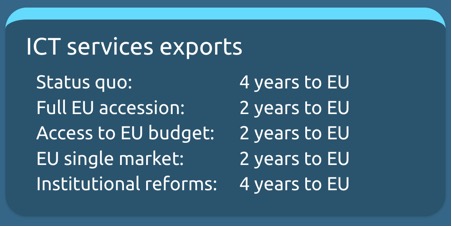
On current trends, according to converge2eu scenarios, Serbia will reach the EU average in digitalisation within two to four years.
Source: www.converge2.eu
In a sector that reflects the broader competitiveness of an economy, that is a significant milestone — and it is happening independently of Serbia’s formal accession status.
Digital convergence has been market-led and domestically driven. EU frameworks have supported the direction of travel, but the engine has been economic opportunity, not political conditionality.
That distinction matters: it means progress in this area is structurally resilient, even as accession talks remain frozen.
EU cooperation has nevertheless helped reinforce the trajectory, through instruments such as IPA funding and, more recently, the EU Growth Plan for the Western Balkans, where digitalisation is strongly supported under Sub-area 7.2 and Reform 7.2.2 on the further digitalisation of public services and administrative procedures for businesses and citizens. This includes alignment with the EU digital identity framework and eIDAS regulation, paving the way for the introduction of a digital identity wallet and more secure, interoperable, and user-friendly digital services that can be accessed fully online.
Digitalisation may be the clearest evidence available that convergence is not only a political process, it is also happening through technology, markets, and institutional reform.
The next challenge: from outsourcing to innovation
Despite this success, the future will bring new challenges.
Much of Serbia’s ICT growth has been based on providing outsourcing services to companies in Western Europe and other advanced economies.
This model has helped create jobs and attract investment. But it also raises questions about long-term sustainability.
See content credentials

As Serbia’s economy grows and wages increase, the country may gradually lose its advantage as a lower-cost outsourcing destination. Other regions, including parts of North Africa or Asia, could become more competitive in that role.
For Serbia’s digital sector to continue growing, the next step will be to develop more domestic products, platforms, and intellectual property.
In other words, the challenge will be to move from being primarily a service provider to becoming a source of innovation and digital entrepreneurship.
This transition is already beginning, but it will require continued investment in education, research, and technological development.
Returning to the (digital) office
And as Nenad closes the tab and returns to his next meeting, the process already fades into the background—just another task completed without friction, without interruption.
Later that evening, walking home through the familiar streets of Belgrade, he passes by the same police administration office where, not so long ago, he would have spent hours waiting his turn. The queue is shorter now. The urgency is gone. The building is still there, but its role has quietly changed.
Nenad barely notices.
For him, this is simply how things work.
Yet, it is precisely in these almost invisible shifts—where time is saved, effort reduced, and services adapt to people’s lives—that a deeper transformation becomes visible. What once required presence and patience now happens in the background of a normal workday, seamlessly integrated into everyday routines.
And so, on another busy workday in Belgrade, Nenad remains at his desk, fully occupied with meetings and deadlines—unaware that even the smallest administrative task has become part of a much larger story.
Find out all about the data on convergence of Western Balkan countries with EU living standards at www.converge2.eu