A European Future at Home: Montenegro’s Employment Story
On most evenings, Balša sits at a café near the Morača River in Podgorica, watching the city change around him.
Three years ago, the conversations were different. The pandemic had hit Montenegro hard. Tourism collapsed. Construction slowed. Jobs disappeared almost overnight and leaving the country for work was common among people of all ages.
Back then, Balša wondered whether his future also lay somewhere else.
Today, he manages logistics for a tourism supplier working across the Montenegrin coast. His younger sister recently found her first formal full-time job. His parents’ small business has more customers again. Podgorica feels busier, louder, more optimistic, jobs are more secure and formalized.
And in many ways, Montenegro itself is beginning to look more European.
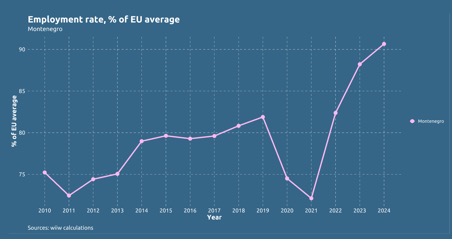
According to the Converge2EU dashboard, Montenegro’s employment rate has already reached 91% of the EU average, making it one of the strongest convergence stories in the Western Balkans. At the current pace, the country could theoretically reach the EU employment average within five years.
For Balša, those statistics are no longer abstract indicators buried inside EU reports.
The Return of Optimism
The economic shutdown and halted travel during the coronavirus pandemics resulted in a GDP drop of over 15% in 2020. But the recovery came quickly.
Tourists returned to Budva and Kotor. Constructions continued and restaurants were back in business.
At the same time, the government introduced the Europe Now reforms, increasing minimum wages and lowering labour taxes. Formal work became less expensive for the employers, more valuable for the workers. And avoiding the rules wasn’t paying off anymore.
Source: www.converge2.eu
EU accession is not only about negotiating chapters in Brussels. It is about whether citizens begin to believe their future can be built at home.
And in employment terms, Montenegro is moving closer to Europe faster than many expected.
The country’s employment rate now stands at 64%, close to EU levels. Unemployment has fallen significantly.
But the deeper converge2eu data also reveal another reality: Montenegro is converging unevenly.
So Close to Europe
Balša earns more than he did before the pandemic. But when he compares his life to friends working in Ljubljana or Vienna, the gap still feels enormous.
And the numbers confirm it.
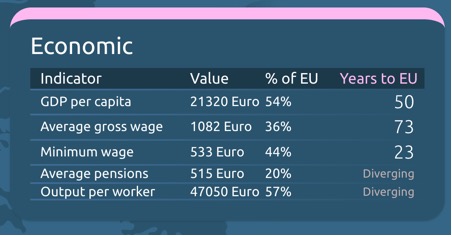
While Montenegro has reached 91% of the EU average in employment, average wages remain only 36% of EU levels. Infrastructure convergence stands at just 30%. Poverty indicators remain at only 54% of the EU average, and productivity trends are still diverging.
Source: converge2.eu
That contradiction defines Montenegro’s convergence story. The country is becoming better at creating formal jobs than at creating European-quality living standards.
“Montenegro has become better at pulling people into work, but much less successful at turning work into EU-level living standards.”
Rents have increased faster than salaries. Many jobs remain seasonal and insecure. Friends from northern Montenegro still struggle to find stable opportunities without moving south or abroad. For those working in tourism, contracts often disappear after summer.
The statistics say convergence. The lived experience still feels fragile.
The European Question for Montenegro
Converge2eu’s broader findings show that Montenegro’s strongest progress is concentrated in employment and digitalisation, while weaknesses remain in infrastructure, governance, education quality, and productivity.
Source: converge2.eu
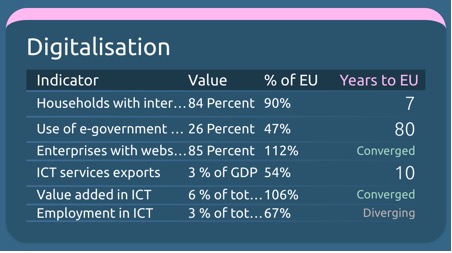
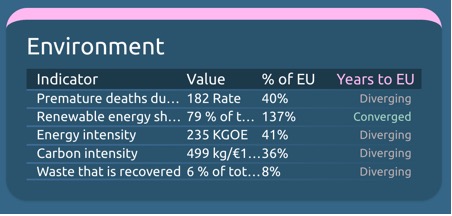
The country’s ICT sector is already above the EU average in value added, internet access is close to convergence, and renewable energy capacity significantly exceeds EU levels.
Source: converge2.eu
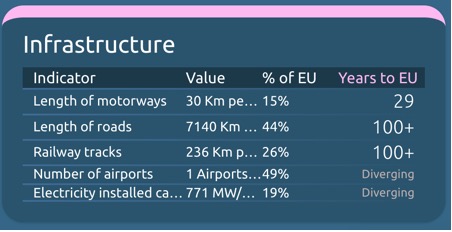
But other indicators tell a more difficult story: railway infrastructure remains only 26% of the EU average, motorways stand at just 15%, rule of law indicators are diverging, and poverty reduction could take decades at the current pace to reach EU average.
Source: converge2.eu
That is why Montenegro’s accession story increasingly revolves around one central question:
Can the country transform short-term labour-market momentum into long-term European living standards?
Because it is not simply about more people working legally. It is about whether this work creates security, dignity, and stability.
From Employment Convergence to Decent-Work Convergence
Experts increasingly warn that Montenegro’s recent success rests heavily on tourism, construction, consumption, and wage increases by simple tax reallocation rather than by growth.
The converge2eu annual report similarly warns that vulnerable groups still benefit less from labour-market improvements because of persistent informality, regional disparities, weak activation policies, and insufficient childcare support.
For Balša, these structural weaknesses are not theoretical. They shape ordinary, everyday decisions: whether he can realistically afford an apartment in Podgorica, whether starting a family feels financially possible, whether salaries will continue rising, and whether Montenegro can sustain its progress without putting too much pressure on public finances.
That is why the next phase of convergence will not simply be about creating more jobs. Montenegro has already shown that it can increase employment and bring more people into the labour market.
“The real test is whether employment convergence can become decent-work convergence.”
The bigger challenge now is creating better jobs: more productive jobs, more formal jobs, better-paid jobs, and opportunities that are not concentrated only in Podgorica and along the coast. The real test of convergence will be whether economic growth can translate into long-term stability, higher living standards, and a stronger sense that a European-quality future can genuinely be built at home.
The Europe Montenegro Is Building
Late in the evening, the terraces in Podgorica remain full. Balša watches the movement around him — students finishing classes, tourists crossing the city centre, construction workers ending long shifts, young professionals talking about new opportunities and debating inflation. The atmosphere feels very different from the uncertainty that defined the years after the pandemic. The city feels more confident, more dynamic, more connected to the rhythm of Europe.
And in many ways, Montenegro is moving closer to the European Union not only through negotiation chapters or political declarations, but through everyday economic life.
As the lights reflect off the Morača River and the city slowly quiets down, Montenegro’s European journey feels closer than it did a few years ago. Yet the real test of convergence is only beginning: whether the country can transform today’s optimism into a long-term European standard of living that citizens like Balša no longer feel they need to search somewhere else. Find out more about the data at https://converge2.eu/country/Montenegro