A Safe Beginning: How North Macedonia Transformed Newborn Care
On a calm morning in Skopje, Jovana holds her baby for the first time.
The room is quiet. A nurse checks in, offers a few final instructions, and reassures her that everything is going well. Within a day, Jovana and her baby will return home—healthy, safe, and supported.
For her, this feels natural. Almost expected.
But not long ago, it was far less certain.
From Risk to Results
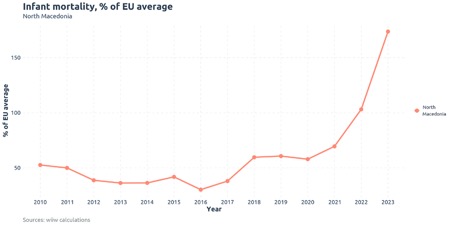
A decade ago, giving birth in North Macedonia carried significantly higher risks for newborns than in most EU countries. In 2016, the country was still far from the EU average in neonatal mortality, and closing that gap appeared to be a long-term challenge. Something that might take decades.
Instead, the turnaround came with unexpected speed.
Neonatal mortality dropped from 8.1 to 1.1 deaths per 1,000 live births in less than a decade—one of the fastest improvements recorded globally.
Source: WIIW
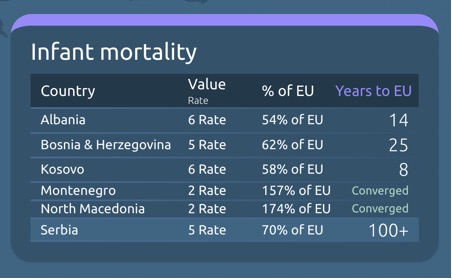
By 2022, North Macedonia had reached the EU average. Today, it performs even better, achieving 174% convergence in this indicator.
Source: converge2.eu
For families like Jovana’s, this transformation is not visible in charts or indicators. It is felt in the experience itself, in the confidence that care will be there when it matters most.
The System That Turned
This progress did not come from a single reform or one moment of change. It was the result of a coordinated effort that gradually reshaped how maternal and newborn care is delivered. Over time, institutions, healthcare professionals, and international partners aligned around a clear objective: reducing preventable newborn deaths.
See content credentials
In particular, this was a coordinated effort among national institutions and international partners. Working alongside the Ministry of Health of North Macedonia, UNICEF, WHO, and UNFPA North Macedonia helped strengthen neonatal care through targeted investments in health workforce training and the standardisation of maternity ward protocols, notably within the framework of the Safe Motherhood Committee.
Efforts also focused on improving equity in access to care, with a particular emphasis on vulnerable groups, including Roma communities, through expanded sexual and reproductive health services and support for national strategy development. In some cases, this meant bringing services directly to families through mobile medical teams, closing gaps that statistics alone often fail to capture.
At facility level, interventions supported upgrades in maternity infrastructure, including the University Clinic for Gynecology in Skopje, alongside continuous training for medical staff. A key element of this approach has been the introduction of perinatal mortality audits in line with WHO guidance, helping identify systemic gaps and improve essential newborn care.
And what mattered was not only the design of reforms, but their consistent implementation across the system.
Beyond the Hospital Walls
What makes this transformation particularly notable is that it did not only improve outcomes in the most critical cases. It raised the overall quality of care. From pregnancy to childbirth and the first days of life, services became more consistent, more responsive, and more accessible.
See content credentials

The effects of these changes extend beyond the hospital setting. For families, better maternal and newborn care strengthens trust in the health system and provides a sense of security at one of the most sensitive moments in life.
In a country facing demographic pressure and low fertility rates, this kind of progress carries broader significance. It contributes to social confidence, supports decisions about starting and growing families, and ultimately feeds into the long-term resilience of the economy.
Great Success in a Strained System
At the same time, this success exists alongside ongoing challenges. North Macedonia continues to face structural weaknesses in its health system, including limited progress in areas such as life expectancy and the availability of medical professionals.
“This case shows that even in a constrained system, strong coordination, targeted reforms, and professional commitment can produce measurable and durable results. With sufficient funding, we can support our expertise to make changes for the better.”
In other areas within healthcare, progress has been slower, largely due to the absence of sustained, structured implementation and practical system-wide reforms. While National Strategies and Action Plans exist across most sectors of the health system, their financing and execution often lag behind expectations, and in some cases remain incomplete. Although comprehensive strategies are in place for nearly every segment of healthcare, only a limited number have translated into results comparable to those achieved in neonatal care. A key constraint is the difficulty of maintaining political commitment to reforms whose full impact extends beyond a typical electoral cycle, which can weaken continuity and reduce the effectiveness of long-term policy efforts.
Not Just About Healthcare
This story shows that even within constrained systems, meaningful and measurable progress is possible when political will, professional expertise, and coordinated support align around a clearly defined goal.
In a context of demographic ageing and persistently low fertility, improvements in reproductive and newborn care extend well beyond the health sector. They shape how families perceive stability, quality of life, and the state’s ability to provide support at one of life’s most sensitive moments.
“What stands out is not only the speed of the improvement, but its durability. The results have not only been achieved but they have been sustained.”
The implications are also economic. Sustained low fertility affects labour markets, the long-term viability of social systems, and overall growth prospects. Strengthening care for mothers and infants therefore contributes not only to better health outcomes, but also to the broader conditions needed for demographic renewal and a more resilient economy. In this sense, such targeted improvements can reinforce both social confidence and long-term economic sustainability.
What Comes Next
Looking ahead, the pace of convergence is likely to stabilise. The rapid acceleration seen between 2016 and 2022 will be difficult to replicate. Future progress will therefore depend less on momentum alone and more on sustaining funding, strengthening institutional coordination, and ensuring that trained professionals remain within the system.
Building on these foundations, the 2026–2030 Country Programme places maternal health and neonatal survival at the centre of efforts to further strengthen the responsiveness and resilience of the health system. Progress in this area is not the result of a single intervention, but of a combination of mutually reinforcing efforts: implementing the 2020–2030 Perinatal Care Masterplan, introducing rigorous, evidence-based perinatal audits, and maintaining close cooperation between NGOs and institutional teams working towards a shared objective.
Taken together, this experience shows that if EU funding can be used in a coordinated and goal-oriented way, it can generate tangible results across sectors. The sustained collaboration between civil society and public institutions demonstrates that structured partnership can translate policy frameworks into measurable outcomes.
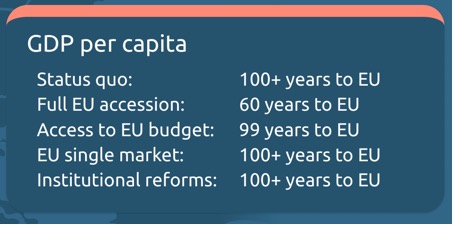
converge2eu data shows that a full EU accession would significantly reduce the GDP per capita convergence gap between North Macedonia nad the EU average. Source: converge2.eu
While the effects are indirect, progress in maternal and neonatal health also contributes to EU accession readiness. It strengthens human capital and signals that public institutions are capable of delivering concrete, system-wide improvements. This aligns with the EU’s Growth Plan for the Western Balkans, which emphasises faster socio-economic convergence and deeper reform implementation, as well as with North Macedonia’s reform priorities that link human capital development—particularly in health, education, and social protection—to more inclusive growth, higher labour market participation, and better responses to demographic ageing. In this sense, improvements in maternal and infant health are not only a public health achievement; they also reinforce long-term productive capacity, social resilience, and the credibility of the state as a reform-implementing actor.
The invisible moments of transformation
Back in the maternity ward, however, these complexities are not visible.
As Jovana prepares to leave, everything feels routine. The check-ups, the guidance, the care, it all happens without urgency, without uncertainty. She steps outside, carrying her child into a normal day.
For her, this is simply how things work.
Yet it is precisely in these almost invisible moments that a deeper transformation becomes clear. What once carried risk and uncertainty has become part of everyday life—predictable, reliable, and safe.
This is what convergence looks like when it reaches people. 👉 Explore the full data and convergence scenarios at converge2.eu